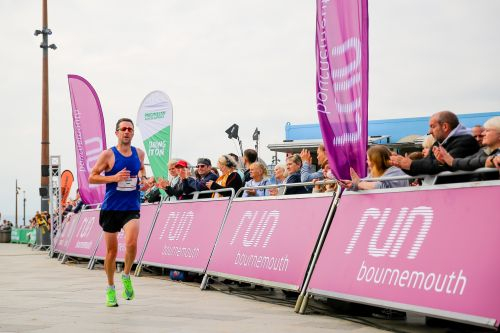
Run Bournemouth presents an idyllic public face: sea views, two famous piers, a lively promenade and runners celebrating beside Bournemouth Pier Approach. Behind that coastal experience is a complicated operation spread across two days, several race distances and a course exposed to weather, tides and heavy public use.
The programme includes junior races, a Supernova 5K, the Supersonic 10K and Bournemouth Half Marathon. Saturday’s events are concentrated around Bournemouth Prom and Lower Gardens, while Sunday’s races begin at Hengistbury Head and finish in central Bournemouth.
Making those events feel effortless requires detailed planning by course teams, volunteers, medical professionals, transport coordinators and race-control staff.
Turning a Busy Seafront Into a Race Venue
Bournemouth’s coastline is not an empty sporting arena. The promenade, piers, gardens and clifftop roads are used by residents, businesses and visitors throughout the year.
The course team must design routes that accommodate runners while preserving emergency access and managing other users. Every transition between road, promenade, pier and overcliff introduces a different operational consideration.
The surface on a wooden pier behaves differently from a road. Promenade sections can contain sand, standing water or street furniture. Clifftop areas may be exposed to strong winds, while ramps and inclines affect the speed and density of runners.
The route must also be measured accurately and supported with signage that remains clear after dark during the Supernova 5K and in daylight for Sunday’s events.
Planners assess where barriers are needed, where spectators may gather and where runners travelling in different directions must be separated.
Two Days, Several Different Audiences
A junior race requires different procedures from a half marathon. Children need secure start and collection systems, clear communication with parents and event staff who understand safeguarding responsibilities.
The Supernova 5K adds the challenges of dusk and darkness. Lighting, visibility and reflective signage become operational priorities. Participants may wear elaborate illuminated costumes, creating a joyful atmosphere but also requiring sufficient space and clear instructions.
On Sunday morning, the operation changes again. The 10K and half marathon attract larger fields, use a point-to-point format and require transport to Hengistbury Head.
The event team must reset facilities between races, adjust barriers and ensure that participants for one event do not enter areas reserved for another. Timetables are built with enough separation to manage these transitions without losing the weekend’s festival atmosphere.
Building the Start at Hengistbury Head
Hengistbury Head is visually spectacular but operationally constrained. Parking is limited, roads can become congested and the natural environment must be protected.
Participant arrival therefore needs careful management. Event buses bring runners and spectators from designated locations, while controlled drop-off arrangements reduce pressure on local roads.
Staff position toilets, baggage facilities, pens and information points so thousands of people can move through a relatively limited space. Start teams monitor queues and communicate with race control if arrivals are delayed.
Baggage must be loaded for transport to the central finish. Each vehicle needs an assigned sequence and secure route, ensuring bags are ready before runners arrive at Bournemouth Pier Approach.
Once the field leaves, the start team begins dismantling facilities and restoring the site.
Volunteers: The Human Face of the Weekend
Volunteers welcome nervous children, answer transport questions, distribute water and guide runners through unfamiliar sections of the course.
Their briefing must be specific. A marshal near Boscombe Pier has different responsibilities from someone managing a junior collection area or finish-line refreshments.
Course marshals watch for members of the public entering the route, identify surface hazards and report incidents. On the promenade, they may need to manage interactions between runners, pedestrians and cyclists.
At night, volunteers must remain visible and understand how to direct participants without shining lights into their eyes. During the half marathon, they may spend hours in exposed coastal conditions.
The enthusiasm spectators associate with Run Bournemouth is not accidental. Volunteers help create it while also performing essential safety and communication functions.
Monitoring Coastal Weather
Weather is one of the event’s least controllable variables. Wind can be stronger on the clifftops and piers than in sheltered town-centre streets. Rain may affect surfaces, visibility and participant temperature.
The operations team monitors forecasts in the days leading up to the event and continues assessing conditions throughout the weekend.
Medical resources are planned for a range of scenarios. Warm weather can increase dehydration and heat-related illness, while cold rain may leave slower participants at risk of becoming chilled.
The medical team includes personnel at fixed treatment points and responders able to reach incidents along the route. Their deployment considers access: reaching a runner on a promenade or pier may require a different response from attending someone on an open road.
At the finish, volunteers and clinicians look for runners who appear confused, unsteady or unusually distressed.
Race Control and Course Communication
Race control receives information from across Bournemouth, Boscombe and Hengistbury Head. It tracks the field, coordinates medical responses and monitors pressure points.
If sand blows onto the promenade, a barrier moves or a member of the public enters the course, the relevant team can be dispatched. Race control also communicates with transport staff when buses encounter delays.
Reliable radio communication matters because mobile phones may not provide the speed or clarity needed during an incident. Teams use agreed call signs and reporting procedures to avoid confusion.
The control team must understand the relationship between each race. A delay to one start can affect road closures, volunteer shifts and later events.
Decisions are documented so the post-event review can examine not only what happened, but why a particular response was chosen.
Managing the Finish at Bournemouth Pier Approach
The finish area needs to absorb runners arriving at very different speeds while remaining welcoming to spectators.
Timing equipment records each finish, but runners must continue moving after crossing the line. Volunteers distribute medals, hydration and other finishers’ items in an order designed to prevent queues building backwards.
Baggage collection needs to be close enough for convenience but far enough away to protect the finish flow. Reunion spaces help separate waiting families from athletes leaving the controlled area.
Saturday’s junior events require particularly careful collection arrangements. Adults need to understand where children will emerge, and staff must know what to do when a parent is delayed.
Lower Gardens provides useful space, but every pathway must be considered. Public access, emergency routes and event facilities all compete for limited central ground.
Road Closures and Community Relationships
Run Bournemouth affects residents, hotels, cafés and seafront businesses. Road closures and parking suspensions must be communicated early and accurately.
The event team works with local authorities and transport operators to plan diversions. Marshals are then deployed at key access points to protect runners and respond to questions.
Cleaning crews follow the race, collecting bottles, signage and other waste. Roads and promenades cannot reopen until equipment has been removed and the surface is safe.
Respect for the coastal environment is also important. Temporary infrastructure must be installed without unnecessary damage, and waste must not be allowed to reach the beach or sea.
The Final Runner Is Not the End
After the last finisher, staff dismantle the course, reconcile equipment and process any remaining medical or operational incidents.
Timing data is reviewed, lost property logged and participant questions answered. Transport teams continue working until people and vehicles have left the site.
A formal debrief examines bus demand, start queues, course access, medical activity and finish-line movement. Feedback from volunteers and participants helps identify improvements.
Run Bournemouth’s polished seaside image is made possible by people working in car parks, control rooms, baggage vehicles and exposed course positions. Their success is measured partly by how little of that complexity the runner ever notices.